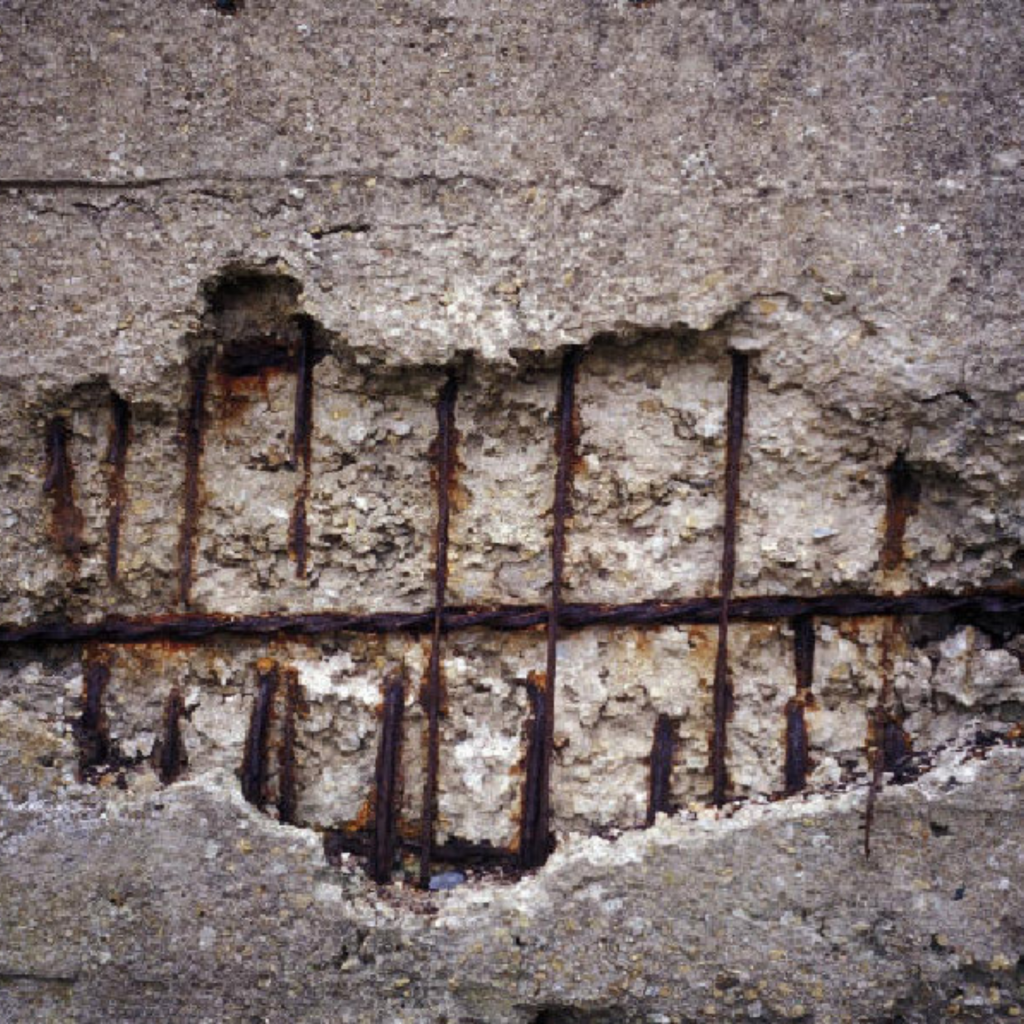

Understanding corrosion mechanics in parking garage rehabilitation
Concrete in Compression. Chlorides in Control.
Garages are not just buildings. They are load paths under attack.
Unlike typical structures, parking garages endure a perfect storm of structural fatigue
- Live loads from vehicles
- Repeated deicing salt exposure
- Thermal cycling from seasonal extremes
- Moisture infiltration from above and below
Over time, this environment initiates a well-known but insidious process: chloride-induced corrosion of embedded steel reinforcement. As chlorides migrate through the concrete, they disrupt the passive oxide layer protecting the rebar triggering corrosion, expansion, and cracking.
The result? Delamination, spalling, and ultimately, loss of structural section.
Scientific principles at play:
- Fick’s Second Law governs chloride diffusion in concrete.
- Faraday’s Law allows us to estimate steel loss over time.
- AASHTO and ICRI repair protocols guide patching, crack injection, and re-alkalization strategies.
Restoring a garage means more than replacing concrete. It means reestablishing electrochemical balance, recalibrating load paths, and restoring the garage’s ability to fight back quietly, molecularly, structurally.
When a slab fails, it does not send a warning.
It just gives in.